 +1 (417) 221-3749
 Live Chat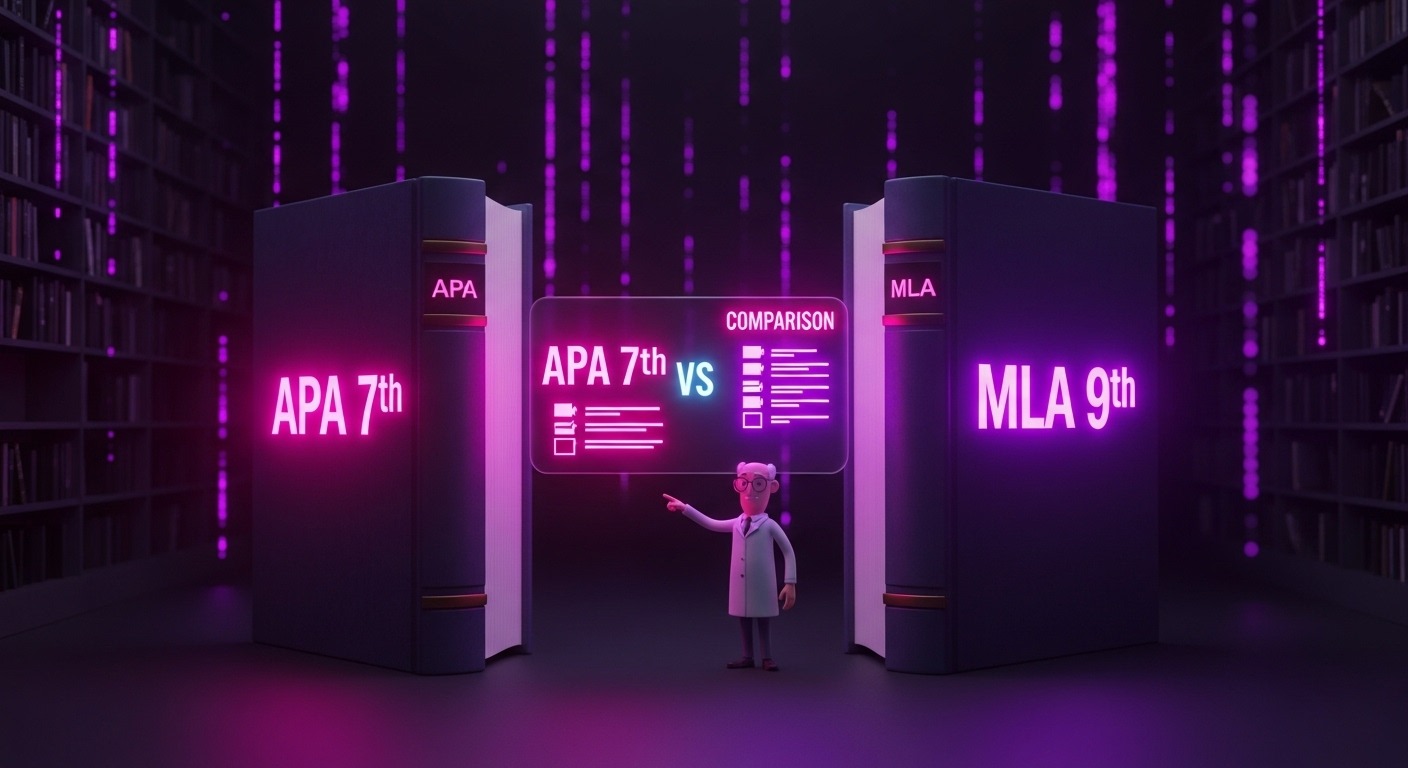
What Makes APA and MLA Different at Their Core
APA and MLA serve the same purpose, accurate source attribution, but they organize citation information differently.
APA emphasizes publication dates and research recency, while MLA focuses on source location within a text.
This difference shapes how citations appear throughout academic writing.
When Academic Disciplines Decide Which Format to Use
Universities assign citation styles based on the academic field.
APA style dominates in disciplines that rely on current research and data analysis, including:
- Psychology
- Sociology
- Education
- Business
- Nursing and health sciences
These fields depend on up-to-date research findings. APA's author-date format highlights the publication year so readers immediately see how recent the research is.
MLA style, on the other hand, appears most often in humanities fields such as:
- Literature
- Cultural studies
- Language studies
- Philosophy
These subjects analyze texts rather than recent experimental research. MLA therefore focuses on page location within a source, which helps readers locate passages in books or articles.
How Each Style Approaches Source Attribution
APA structures citations around who wrote the source and when it was published.
A typical APA citation includes:
- Author name
- Publication year
- Page number (when quoting)
MLA organizes citations around who wrote the source and where the information appears in the text.
An MLA citation includes:
- Author name
- Page number
Publication dates appear only in the works cited entry.
This structural difference explains why the two styles look different throughout an academic paper.
A Side-by-Side Look at Page Setup and General Formatting
Both citation systems use standard academic formatting conventions.
Shared formatting features include:
- 1-inch margins on all sides
- Double-spacing throughout the document
- Readable fonts such as Times New Roman
- Left-aligned text
However, key formatting elements differ.
| Feature | APA 7th Edition | MLA 9th Edition |
|---|---|---|
| Title page | Required for most papers | Usually not required |
| Page header | Page number only (student papers) | Author last name + page number |
| Reference page title | Reference List | Works Cited |
| Citation emphasis | Author + date | Author + page |
These structural differences influence how a research paper is formatted from the first page to the bibliography.
In-Text Citation Rules APA 7th vs MLA 9th
In-text citations connect ideas within a paper to the full bibliographic entry at the end.
Both styles use parenthetical citation, but the elements inside the parentheses follow different rules.
How APA 7th Edition Handles Author-Date In-Text Citations
APA relies on the author-date format.
A basic APA citation looks like this:
(Smith, 2021)
When quoting directly, the citation includes a page locator.
Example:
(Smith, 2021, p. 45)
APA also allows a narrative citation, where the author's name appears in the sentence.
Example:
Smith (2021) explains that cognitive bias influences decision-making.
This approach integrates sources smoothly within academic discussion.
How MLA 9th Edition Uses Author-Page In-Text Citations
MLA uses the author-page format.
Example:
(Smith 45)
MLA citations omit the publication year.
The assumption is that readers will locate the full publication details in the Works Cited entry.
MLA also encourages the use of signal phrases to introduce sources.
Example:
According to Smith, cultural context shapes literary interpretation (45).
This style places emphasis on the author's argument rather than the publication date.
Citing Multiple Authors: Where the Two Formats Diverge
APA and MLA treat multiple authors differently.
APA citation rules:
- Two authors → (Smith & Jones, 2022)
- Three or more authors → (Smith et al., 2022)
MLA citation rules:
- Two authors → (Smith and Jones 45)
- Three or more authors → (Smith et al. 45)
Both styles use et al. for sources with multiple contributors, but punctuation rules differ.
Paraphrasing vs Direct Quotes Citation Treatment in Both Styles
Both citation systems require attribution when paraphrasing.
However, page numbers are optional in APA when paraphrasing, but recommended in MLA.
Example APA paraphrase:
(Smith, 2021)
Example MLA paraphrase:
(Smith 45)
Direct quotations require page references in both formats.
No Author, No Date: How Each Format Fills the Gap
Sources sometimes lack author names or publication dates.
APA replaces missing authors with the title of the work.
Example:
("Climate Policy Review," 2020)
MLA uses a shortened title in place of the author.
Example:
("Climate Policy Review" 4)
When dates are unavailable, APA uses n.d. (no date).
These adjustments maintain citation consistency across different source types.
Building the Reference Page APA Format vs MLA Works Cited
At the end of an academic paper, both styles include a full list of sources.
APA calls this section the Reference List, while MLA uses the term Works Cited.
Both require a hanging indent for each bibliographic entry.
How APA 7th Structures a Reference Entry
APA references follow a structured order:
Author. (Year). Title. Publisher. DOI or URL.
Example:
Smith, J. (2021). Social behavior in digital environments. Oxford University Press.
APA encourages including a DOI for journal articles whenever available.
A DOI acts as a permanent identifier that links directly to the original publication.
How MLA 9th Builds a Works Cited Entry
MLA entries rely on a layered structure called the container system.
Each container represents the source where the work appears.
Example MLA entry:
Smith, John. Social Behavior in Digital Environments. Oxford University Press, 2021.
The MLA handbook encourages adding an access date when citing online sources.
Journal Articles Reference Format in APA vs MLA
APA journal citation:
Smith, J., & Lee, R. (2020). Digital literacy in education. Journal of Educational Research, 45(2), 120–134. https://doi.org/xxxxx
MLA journal citation:
Smith, John, and Robert Lee. "Digital Literacy in Education." Journal of Educational Research, vol. 45, no. 2, 2020, pp. 120–134.
APA emphasizes publication year and DOI.
MLA emphasizes journal volume, issue number, and page range.
Books and Edited Volumes Entry Differences Explained
APA book citation:
Smith, J. (2020). Digital communication studies (2nd ed.). Cambridge University Press.
MLA book citation:
Smith, John. Digital Communication Studies. 2nd ed., Cambridge University Press, 2020.
MLA includes the edition number earlier in the entry.
Websites and Online Sources: A Practical Comparison
APA website citation:
Author. (Year). Page title. Website name. URL
MLA website citation:
Author. "Page Title." Website Name, Publisher, Date, URL.
MLA sometimes includes a publisher location or sponsoring organization.
APA prioritizes publication date and direct link accessibility.
Citation Examples by Source Type APA and MLA Compared
Citation differences become clearer when examining specific source types.
Citing a Book with One Author
| APA Example | MLA Example |
|---|---|
| Smith, J. (2021). Digital society. Routledge. | Smith, John. Digital Society. Routledge, 2021. |
Citing a Journal Article with Multiple Authors
| APA Example | MLA Example |
|---|---|
| Smith, J., Lee, R., & Patel, A. (2022). Online learning patterns. Educational Studies, 30(2), 50–65. | Smith, John, et al. “Online Learning Patterns.” Educational Studies, vol. 30, no. 2, 2022, pp. 50–65. |
How to Cite a Website Page in APA 7th and MLA 9th
| APA | MLA |
|---|---|
| Brown, L. (2022). Climate policy updates. Government Portal. URL | Brown, Lisa. “Climate Policy Updates.” Government Portal, 2022, URL. |
Citing a YouTube Video or Podcast
| APA | MLA |
|---|---|
| Channel Name. (Year). Video title [Video]. YouTube. URL | Channel Name. “Video Title.” YouTube, Date, URL. |
Newspaper and Magazine Articles
| APA | MLA |
|---|---|
| Author. (Year, Month Day). Title. Newspaper Name. URL | Author. “Title.” Newspaper Name, Date, URL. |
Government Reports and Institutional Sources
APA often treats government agencies as the author.
MLA lists the organization as the primary author in the works cited entry.
Citing a Chapter in an Edited Book
APA example:
Smith, J. (2021). Media literacy education. In R. Lee (Ed.), Communication research (pp. 120–140). Springer.
MLA example:
Smith, John. "Media Literacy Education." Communication Research, edited by Robert Lee, Springer, 2021, pp. 120–140.
Document Formatting: What APA and MLA Require
Citation rules represent only one part of the formatting process.
APA and MLA also establish document layout standards.
Title Page Requirements: APA Running Head vs MLA Header Block
APA student papers require a title page that includes:
- Paper title
- Author name
- Institutional affiliation
- Course details
MLA typically places this information at the top of the first page.
The MLA header includes:
- Student name
- Instructor name
- Course title
- Submission date
Font, Margin, and Spacing Standards in Each Style
Both citation styles recommend:
- 12-point Times New Roman or equivalent font
- Double spacing
- 1-inch margins
Consistency remains the primary formatting goal.
How Headings Are Formatted Within an APA Paper
APA allows five levels of headings to organize research.
These headings help structure complex research papers.
They appear in bold formatting with specific indentation patterns.
MLA's Approach to Section Titles and Paper Organization
MLA does not require a rigid heading system.
Writers use section titles when necessary for clarity.
This flexibility suits essays focused on textual analysis rather than experimental research.
Footnotes and Endnotes Permitted or Avoided?
APA discourages frequent use of footnotes.
MLA allows them when they provide explanatory notes or additional context.
However, most citations still appear within the main text.
Which Citation Style Belongs in Your Academic Field
Different academic fields rely on citation styles that match their research priorities.
Sciences, Psychology, and Social Sciences: Why APA Is the Norm
APA supports research that evolves quickly.
The author-date format allows readers to evaluate how current the cited research is.
Disciplines such as psychology and education depend heavily on recent empirical studies.
Literature, Humanities, and Language Studies MLA's Domain
MLA suits fields that analyze texts and historical works.
The author-page format helps readers locate passages inside literary sources.
Because publication year matters less in textual analysis, MLA does not highlight dates in citations.
History, Law, and Interdisciplinary Fields: Navigating Mixed Requirements
Some fields rely on additional citation styles such as Chicago.
However, interdisciplinary courses sometimes allow either APA or MLA, depending on the instructor's preference.
Students writing research-heavy papers often need to navigate both formatting systems. If you are working on a research assignment and need formatting guidance alongside writing support, research paper writing assistance from Apex Essays can help ensure your citations and structure meet academic standards.
When an Instructor Specifies Neither Format
If assignment guidelines do not specify a citation style, students should check:
- Course syllabus
- Department writing guides
- Instructor instructions
Consistency across the entire document remains the most important rule.
Frequent Citation Mistakes in APA and MLA and How to Fix Them
Citation mistakes often appear when writers mix formatting rules from multiple styles.
Misplacing the Period Relative to the In-Text Citation
In both styles, the period typically appears after the parenthetical citation.
Incorrect placement disrupts citation clarity.
Inconsistent Author Name Formatting Across Entries
Bibliographic entries must present author names consistently.
Example:
APA: Smith, J.
MLA: Smith, John.
Mixing formats creates confusion in the reference list.
Missing or Incorrect DOI and URL Formatting in APA
APA requires DOIs for scholarly journal articles when available.
Writers sometimes omit these identifiers, which reduces source traceability.
Using Outdated Edition Rules
APA updated several rules between the 6th and 7th editions, including:
- Citation of multiple authors
- DOI formatting
- Running head requirements
MLA also introduced new guidelines in the 9th edition, particularly regarding optional elements.
Conflating the Two Styles in a Single Document
Mixing citation systems remains one of the most common formatting errors.
Annotated bibliographies amplify these mistakes since each entry includes both citation formatting and analysis. Students who need structured help with formatted source lists often explore annotated bibliography writing support from Apex Essays to understand how citation structure translates into full academic entries.
APA 7th Edition Key Updates and Citation Rules
The latest edition of the APA Publication Manual introduced several changes designed to simplify academic formatting.
What Changed from APA 6th to 7th Edition
Major updates include:
- Simplified DOI formatting
- More flexible font choices
- Updated guidelines for inclusive language
These changes reflect evolving academic writing standards.
How APA 7th Handles Three or More Authors
Earlier editions listed multiple authors in the first citation.
APA 7th simplifies this process by using et al. for sources with three or more authors.
Example:
(Smith et al., 2021)
Citing Secondary Sources and Personal Communications
APA allows citations of personal communication, such as interviews or emails.
These citations appear only in the text, not in the reference list.
APA Format for Tables, Figures, and Appendices
APA provides detailed instructions for visual data presentation.
Tables and figures require numbered labels and descriptive titles.
Appendices appear after the reference list.
Running Head Requirements Removed: What That Means
Student papers no longer require a running head unless specified by the instructor.
APA formatting remains precise, especially for complex research documents. When citation accuracy and formatting consistency become critical, some students seek professional APA paper writing help through Apex Essays to ensure every section follows the publication manual correctly.
MLA 9th Edition: What is New and How It Works
MLA's latest edition focuses on flexibility across different source types.
Core Changes Introduced in MLA 9th Edition
The update introduced guidance on:
- Inclusive language
- Digital media citation
- Expanded guidance for online sources
The Container System: How MLA Organizes Source Layers
MLA's container system identifies the structure of a source.
For example:
Article → Journal → Database
Each layer forms part of the citation entry.
Optional Elements in MLA 9th: When to Include Them
MLA allows optional details such as:
- Access date
- Version number
- Database name
These elements improve citation precision.
Flexible Format: Why MLA Adapts Across Source Types
MLA's system works across books, websites, podcasts, and multimedia sources.
The structure remains consistent even when the source type changes.
MLA for Digital and Multimedia Sources
Modern research often includes podcasts, streaming media, and online videos.
MLA 9th guides citing these materials within the works cited list.
APA vs MLA at a Glance Comparison Tables for Common Sources
Tables help visualize how the two citation styles differ.
In-Text Citation Format Table
| Citation Style | Basic Format | Example |
|---|---|---|
| APA | Author, Year | (Smith, 2022) |
| MLA | Author Page | (Smith 45) |
Reference vs Works Cited Entry Table
| Source Type | APA Entry | MLA Entry |
|---|---|---|
| Book | Author. (Year). Title. Publisher. | Author. Title. Publisher, Year. |
| Article | Author. (Year). Title. Journal, volume(issue). | Author. “Title.” Journal, vol., no., year. |
Formatting Rules Comparison Table
| Element | APA | MLA |
|---|---|---|
| Title page | Required | Not required |
| Reference section name | Reference List | Works Cited |
| Header | Page number | Author + page number |
Field and Discipline Usage Table
| Field | Citation Style |
|---|---|
| Psychology | APA |
| Sociology | APA |
| Literature | MLA |
| Linguistics | MLA |
Applying the Right Citation Format Scenarios Students Actually Face
Citation rules become clearer when applied to real academic writing situations.
Switching Between APA and MLA Across Different Courses
University students often encounter multiple citation systems across their coursework.
Psychology assignments may require APA, while literature essays require MLA.
Maintaining separate formatting habits helps avoid citation errors.
How to Handle a Paper That Requires Mixed Sources
A single research paper may include journal articles, books, websites, and government reports.
APA and MLA both provide flexible structures that accommodate diverse source types.
Consistency remains the key principle.
Citation Format in Thesis and Dissertation Writing
Long academic projects demand strict formatting consistency.
Citation errors become more visible across large documents such as theses and dissertations. For students working on extended research projects where formatting precision matters throughout the manuscript, thesis writing support from Apex Essays helps ensure citation rules remain consistent from the introduction to the bibliography.
Citation Generators and Manual Verification: What to Trust
Many students rely on citation generators when formatting sources.
These tools help organize bibliographic entries quickly, but manual review remains necessary.
How Citation Generators Handle APA and MLA Differently
Citation generators rely on templates derived from the APA Publication Manual or MLA Handbook.
They fill in required fields such as author, publication year, title, and publisher.
However, incorrect input data often leads to incorrect citation output.
Why Automated Tools Should Be Double-Checked Against Style Manuals
Automated citation tools may miss:
- DOI formatting rules
- capitalization differences
- edition requirements
Reviewing citations against official style guides helps ensure accuracy.
Official Resources: APA Publication Manual and MLA Handbook
The most reliable sources for citation rules remain the official style manuals:
- Publication Manual of the American Psychological Association (7th edition)
- MLA Handbook (9th edition)
These guides provide the authoritative explanation for citation rules used in academic writing.