Live Chat
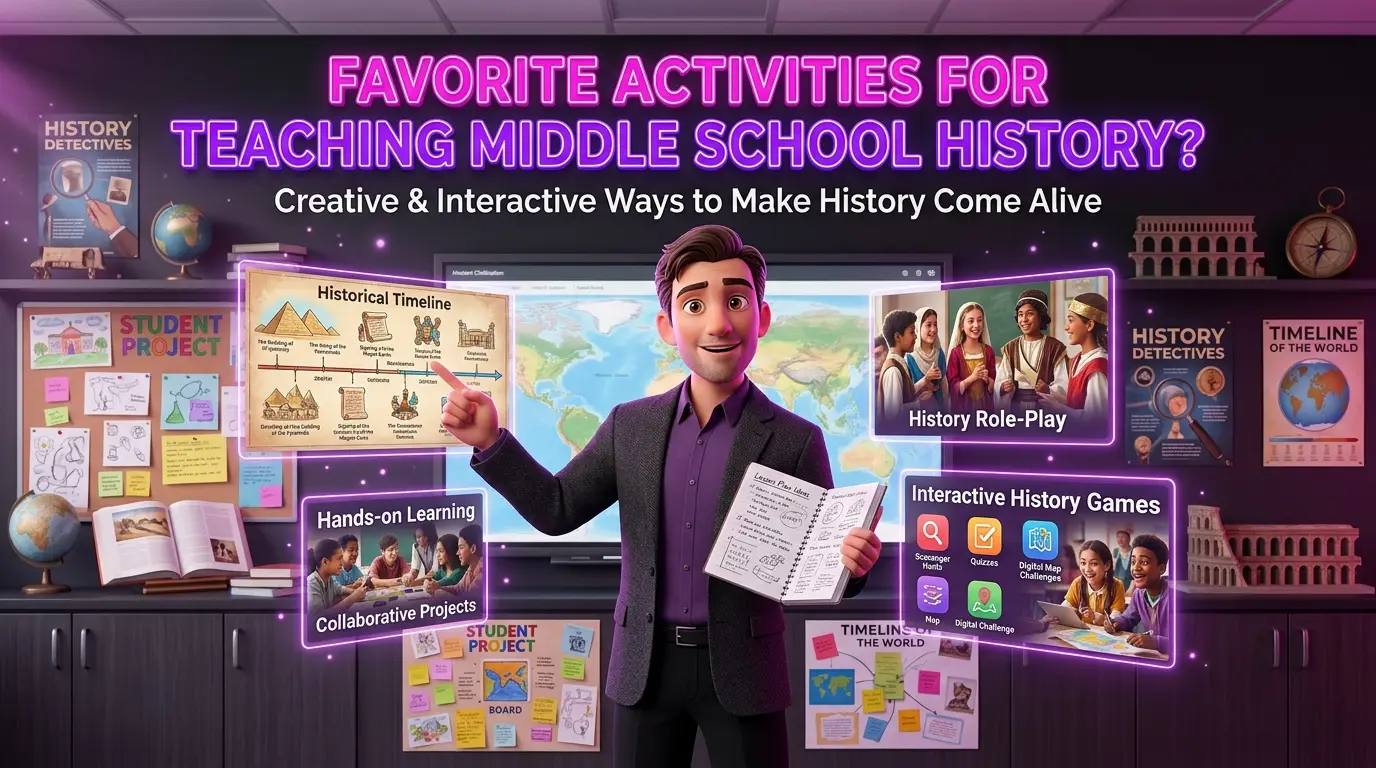
Middle school history works better when students do more than read dates and names. They need to ask questions, study evidence, compare views, and explain what changed over time. A strong history activity gives students a reason to think, speak, write, and defend an idea.
Many history lessons lose energy when students only copy notes. At this age, students learn more when they take part in the lesson. They need movement, choice, group talk, maps, images, documents, and clear tasks that help them see the past as a real story shaped by people and decisions.
Apex Essays supports academic learning by helping students understand how ideas turn into strong written work. History class gives students many chances to build that skill. A classroom debate, a timeline task, or a source study can all lead to better claims, stronger evidence, and clearer writing.
This blog explains favorite activities for teaching middle school history in a way that supports historical thinking, social studies skills, classroom discussion, and student-centered learning.
What Makes a History Activity Work Well in Middle School
A good middle school history activity does not need to feel loud or complex. It needs a clear purpose. Students should know what they must find, compare, explain, or decide.
A strong activity also gives students something to work with. That may include a map, speech, image, letter, chart, timeline, artifact, or short reading. These materials help students move from opinion to evidence.
History teaching works well when the activity matches the thinking skill. A debate helps with a point of view. A timeline helps with cause and effect. A document study helps with evidence. A map helps with place and movement.
Students Need a Clear Role in the Lesson
Students learn more when they know their role. They may act as historians, reporters, museum curators, map readers, or debate speakers. A role gives the lesson shape.
For example, during a unit on the American Revolution, students can act as colonial newspaper writers. They study short source extracts, then write a headline and a short report from one colonial view.
This kind of task helps students see that history depends on evidence and perspective. It also makes the lesson active without turning it into a game with no academic goal.
Good Activities Connect Evidence With a Real Question
A history activity should begin with a question that students can answer through evidence. A question like “Why did colonists protest British taxes?” gives students a purpose.
Students can then study a political cartoon, a short law extract, and a colonist quote. After that, they can build a claim based on what they found.
Apex Essays values this kind of learning because it teaches students how academic writing begins. A clear question leads to evidence, and evidence leads to a strong answer.
Movement Discussion and Choice Help Students Stay Involved
Middle school students often respond well to lessons that include movement and talk. They need chances to stand, sort cards, move between stations, and share short answers.
Choice also matters. Students may choose which source to analyze first, which role to take in a debate, or which event to add to a timeline.
These small choices help students take ownership of the lesson. They also support classroom participation and learning retention.
A Quick Answer Teachers Can Use Before Planning a Lesson
The most useful middle school history activities ask students to investigate, compare, discuss, and explain. Strong options include primary source detective work, human timelines, map tasks, role-play, debate, gallery walks, classroom museum projects, and short evidence-based writing tasks.
Each activity should support one learning goal. Teachers can ask: Do students need to understand sequence, cause, perspective, evidence, geography, or historical impact?
That simple question keeps the lesson focused. It also helps students understand why the activity matters.
Match the Activity to the Skill First
A timeline activity fits lessons about sequence and cause. A document study fits lessons about evidence. A role-play activity fits lessons about historical perspective.
For example, a Civil War unit may use a map activity to show borders, railroads, and major battles. Later, students can use a source study to compare views on union, slavery, and state power.
When the skill comes first, the activity feels useful. Students do not just “do an activity.” They build a history skill.
Use Short Tasks Before Long Projects
Middle school students often need small steps before large projects. A 10-minute source task can prepare them for a full classroom museum or group presentation.
Short tasks also help teachers check understanding. Students can write a one-sentence claim, sort three evidence cards, or place one event on a timeline.
These small moments create better projects later. They help students build confidence before deeper work.
Let Students Explain the Past With Evidence
Students should not end a history activity by saying only what they liked. They should explain what they learned and how they know it.
A simple closing prompt works well:
“What evidence helped you understand this event?”
This prompt helps students connect class activity with academic thinking. It also builds stronger habits for essays, research papers, and discussion posts.
Middle School History Activities That Support Active Learning
Middle school history activities work well when students touch, sort, question, move, and explain. Active learning helps students remember events and link them to larger ideas.
Apex Essays encourages students to treat history as a subject built on evidence, not memorized facts only. The activities below help students practice that mindset.
Primary Source Detective Work
Primary source detective work asks students to study a document, image, speech, diary entry, map, or object from the past. Students look for clues that reveal who created it, why it matters, and what it shows.
Teachers can give students a short source and a simple evidence chart:
This activity builds historical inquiry and primary source investigation. It also helps students avoid broad claims with no support.
Students who need help turning evidence into written analysis may connect this skill with history essay support when they move from class notes to a formal history paper.
Human Timeline for Cause and Effect
A human timeline helps students understand sequence. Each student receives an event card. Students then stand in order based on when the events happened.
After they build the timeline, the teacher asks cause-and-effect questions. Which event caused another? Which event changed public opinion? Which event made the conflict worse?
This activity works well for the American Revolution, the Civil War, reform movements, ancient civilizations, and world wars. It makes time visible and helps students see that events connect.
Historical Figure Decision Chart
This activity asks students to study a historical figure and the choices that person faced. Students create a decision chart with three parts: problem, options, and outcome.
For example, during a lesson on the Constitutional Convention, students can study delegates and their views on representation. They can explain why each person supported a certain plan.
This task helps students see historical figures as real people who made choices under pressure. It also supports historical analysis and perspective.
Map the Event Before Explaining It
Maps help students understand movement, land, power, trade, and conflict. A map activity can make a hard event easier to follow.
Students can mark trade routes, battle locations, migration paths, colonies, or empire borders. Then they explain how geography shaped the event.
This works well for westward expansion, ancient trade networks, the Silk Road, the Civil War, and global exploration.
Interactive History Lessons That Help Students Think Like Historians
Interactive history lessons should do more than keep students busy. They should help students ask historical questions, test claims, and explain events with proof.
These lessons build thinking habits. Students learn to ask who made a source, what point of view it shows, what it leaves out, and how it connects to other evidence.
Station Rotation With Documents, Images, and Maps
A station rotation divides the room into learning spots. Each station includes one source or task. Students move in groups and record short answers.
For example, a lesson on the Great Depression may include:
A photo station
A short speech extract
A chart about jobs
A map of affected regions
A personal account
Students gather evidence from each station. Then they write one claim about how the Great Depression changed daily life.
This structure supports collaboration and keeps reading tasks short. It also helps students compare different types of historical evidence.
Four Corners Debate With Historical Claims
A four corners debate asks students to stand in a corner based on their level of agreement with a claim. The room can show four positions: agree, partly agree, partly disagree, and disagree.
A claim might say:
“The American Revolution changed life for all groups in the colonies.”
Students must choose a position and support it with evidence. Then they listen to other groups and may change their view after hearing stronger proof.
This activity builds classroom discussion, critical thinking, and historical perspectives.
Evidence Sorting for Competing Viewpoints
Evidence sorting asks students to place source cards under different viewpoints. For example, during a lesson on the Constitution, students can sort evidence linked to Federalist and Anti-Federalist arguments.
Students then explain why each piece of evidence fits a view. This teaches them that history often includes debate and mixed evidence.
When students move from source sorting to research work for longer, they can use research paper guidance to understand how evidence, structure, and sources work together.
Silent Discussion Around Historical Questions
A silent discussion gives every student a voice. The teacher writes a historical question on chart paper. Students walk around the room and respond in writing.
They can add a claim, ask a question, or reply to another student. This helps quiet students take part without pressure.
The activity works well before a class debate or essay. It gives students time to think before they speak.
Classroom Activities for Teaching U.S. History
U.S. history gives teachers many chances to use active lessons. Students can study the American Revolution, the Constitution, the Civil War, reform movements, migration, civil rights, and civic life through documents, maps, and role-play.
Strong U.S. history activities help students see how decisions shaped laws, rights, conflicts, and communities.
American Revolution Cause and Effect Chain
A cause-and-effect chain helps students connect events that led to the American Revolution. Each group receives event cards such as the Stamp Act, Boston Massacre, Boston Tea Party, Intolerable Acts, and First Continental Congress.
Students place the cards in order. Then they draw arrows and explain how each event led to the next.
This activity helps students see that the Revolution did not happen in one moment. It grew from conflict, protest, laws, and changing ideas about rights.
Constitution Scenario Cards
Constitution scenario cards help students connect old ideas with real civic questions. Each card gives a simple situation about rights, representation, voting, speech, or government power.
Students decide which part of the Constitution connects to the situation. Then they explain their choice.
This activity supports social studies, civic reasoning, and classroom discussion. It also helps students see why the founding documents still matter.
Civil War Perspective Journal
A perspective journal asks students to write from the view of a person living during the Civil War era. The teacher can assign roles such as a soldier, nurse, enslaved person, factory worker, farmer, or newspaper editor.
Students must use historical facts in the journal entry. They cannot write only feelings. They need evidence from class sources.
This activity helps students develop historical empathy without losing accuracy.
Reform Movement Gallery Walk
A gallery walk works well for reform movements. Groups create short displays about abolition, women’s rights, labor reform, education reform, or prison reform.
Students walk around the room and record what each movement wanted to change. Then they compare goals, methods, and outcomes.
This builds historical understanding and lets students see patterns across different movements.
World History Activities That Make Events Easier to Understand
World history can feel large because it covers many places, time periods, and cultures. Activities help students organize that information.
The goal does not stop at memorizing empires or rulers. Students need to understand movement, trade, belief systems, power, conflict, and change over time.
Ancient Civilization Museum Table
A classroom museum helps students study ancient civilizations through objects and themes. Each group creates a table display for one civilization.
The display may include a map, timeline, artifact drawing, writing sample, social structure chart, and a short explanation of impact.
Students then visit each table and record what each civilization contributed. This activity supports project-based learning and historical comparison.
Trade Route Mapping Activity
Trade routes show how goods, ideas, technology, and religion moved across regions. Students can map routes such as the Silk Road, the trans-Saharan trade, or the Indian Ocean trade.
They mark goods, cities, landforms, and cultural exchange. Then they explain how trade changed societies.
This activity connects geography with history. It helps students understand that movement shapes culture and power.
Empire Comparison Chart
An empire comparison chart helps students compare leadership, economy, military strength, culture, and decline. Students can compare Rome, Han China, Mali, the Ottoman Empire, or the Inca civilization.
The chart should include short evidence notes. Students can then write a short claim about what helped one empire grow or fall.
This activity supports critical thinking and historical analysis.
Turning Points Timeline
A turning point changes the direction of history. Students can build a timeline of turning points in a unit, then explain which event created the largest change.
For example, a world history class may study the fall of Rome, the spread of Islam, Magna Carta, the Renaissance, or global exploration.
Students must defend their choice with evidence. This turns a timeline into a thinking task, not only a date task.
History Projects for Middle School That Build Research Skills
History projects for middle school should help students research, organize, and explain. A project should not become only decoration. It should show thinking.
Apex Essays supports students when they turn research notes into clear academic work. History projects help students practice that process through short claims, source use, and organized ideas.
Mini National History Day Style Inquiry
National History Day projects ask students to explore a historical topic through research and interpretation. A mini version works well in middle school.
Students choose a topic, create a research question, gather sources, and present a short argument. The project can take the form of a display, paper, website, or short presentation.
The teacher can keep the task small. Students may use three sources and one clear claim. This keeps the project focused and age-appropriate.
Classroom Museum Exhibit
A classroom museum exhibit lets students act as curators. Each group studies a person, event, object, or movement and creates an exhibit card.
The exhibit card should explain:
What the item or topic is
Why it mattered
What evidence supports the explanation
How does it connect to the unit question
Students can present their exhibits to classmates. This builds research skills and speaking skills.
Biography Poster With Historical Impact
A biography poster should move beyond birth date and death date. Students need to explain the impact.
The poster can include a timeline, major decision, challenge, quote, source, and lasting effect. Students should answer: What changed because of this person?
This activity works well for historical figures in United States history, world history, science, civil rights, war, government, and reform.
Group Presentation Based on Primary and Secondary Sources
Group presentations help students explain what they researched. The teacher should require both primary and secondary sources.
Students can divide roles: source finder, timeline builder, speaker, image manager, and claim writer. Each student takes part in the academic work.
Students who need help shaping slides for academic tasks can connect this skill with presentation help when classroom research moves into a formal presentation format.
Historical Role-Playing Activities With Clear Learning Goals
Historical role-playing activities work well when students use facts, not random acting. The teacher should give role cards, source notes, and clear questions.
Role-play helps students understand perspective. It also helps them see that people in the past made choices within limits.
Town Hall Debate From a Historical Period
A town hall debate places students inside a historical issue. Each student receives a role and a short position.
For example, a westward expansion debate may include settlers, Native leaders, government officials, railroad owners, and newspaper writers.
Students must speak from their assigned role using historical evidence. The teacher can end with a reflection about whose voices had power and whose voices had less space.
Constitutional Convention Role Cards
Role cards help students understand the debate over representation, federal power, and rights. Each card can include a delegate’s name, state, concern, and position.
Students discuss issues such as large states vs. small states, national power vs. state power, and the need for a bill of rights.
This activity makes the Constitution easier to understand because students see the conflict behind the final document.
Trial of a Historical Decision
A mock trial asks students to judge a historical decision. The class can examine a policy, war decision, law, or public action.
Students take roles as lawyers, witnesses, jury members, and historians. They must use sources as evidence.
This activity builds argument skills and source evaluation. It also helps students learn that historical judgment requires context.
Press Conference With Historical Figures
In a press conference activity, some students act as historical figures while others act as reporters. Reporters ask questions based on the unit.
The historical figures answer using evidence from class sources. This activity works well for reformers, presidents, inventors, explorers, activists, and military leaders.
Students practice quick thinking, speaking, and historical accuracy.
History Games for Students That Still Keep the Lesson Academic
History games can support learning when they focus on recall, evidence, sequence, and cause. The game should connect to the lesson goal.
Teachers can use short games for review or warm-up tasks. The key is to end with a short explanation or written claim.
Vocabulary Relay With Historical Terms
Students work in teams to match terms with meanings, examples, or images. Terms may include republic, boycott, amendment, empire, migration, reform, treaty, or primary source.
After the relay, each student chooses one term and writes a sentence that connects it to the unit.
This keeps the game academic and helps students use vocabulary in context.
Cause and Effect Card Match
Students match causes with effects. For example, they may match “new taxes on colonists” with “protests and boycotts.”
This game works well for revolutions, wars, reform movements, and economic change.
Students can then explain one match in writing. This builds cause-and-effect reasoning.
Source Credibility Challenge
Students receive short source cards. They decide which sources seem more reliable for a certain question.
They must explain their thinking. Who wrote the source? When? Why? What evidence does it include?
This activity supports media literacy and historical inquiry.
Timeline Repair Game
The teacher gives students a timeline with errors. Students must find and fix the mistakes.
They can work in pairs and explain each correction. This helps students study sequences while thinking carefully.
The activity works well before a quiz, discussion, or writing task.
Student-Centered History Learning Through Discussion and Writing
History learning becomes stronger when students explain their ideas. Discussion and writing help them process evidence.
Apex Essays often works with students who need to turn class ideas into academic papers. The same skill starts in small classroom moments.
Short Written Claims After Group Talk
After a group activity, students can write one short claim. The claim should answer the lesson question.
For example:
“The Stamp Act increased colonial anger because it taxed printed materials and made colonists question British control.”
This small task teaches students to connect facts with meaning.
Exit Tickets Based on Evidence
An exit ticket gives students a quick way to show what they learned. It can ask:
“What source changed your thinking today?”
“What event had the largest effect?”
“What claim can you make from today’s evidence?”
These questions support reflection and give teachers a clear view of student understanding.
Discussion Posts That Extend Classroom Thinking
Some classes use online discussion boards after a lesson. Students can respond to a historical question, then reply to classmates with evidence.
This works well after a debate, source task, or film clip. It gives students time to build a more careful answer.
When students need help with academic replies, discussion post support can connect classroom talk with stronger written responses.
How Apex Essays Connects History Learning With Academic Writing
History activities do more than make class more active. They help students learn how to build claims, use evidence, compare sources, and explain meaning.
These are also the same skills students need in essays, research papers, presentations, and class discussions. A strong classroom activity can become the first step toward stronger academic writing.
Turning Classroom Evidence Into Strong Historical Analysis
Historical analysis means more than saying what happened. Students must explain why it happened, how it changed people, and what evidence supports that view.
A source station, role-play, or map activity gives students raw material. Then students can turn that material into claims.
For example, after studying Civil War letters, students can write about how war affected family life, fear, work, or belief.
Moving From Activity Notes to Essay Claims
Many students take notes during an activity, but do not know how to use them later. A simple method can help.
First, students circle one key fact. Next, they explain what that fact shows. Then they turn that idea into a claim.
Apex Essays uses this same logic in academic support. Strong writing starts when students know what their evidence proves.
Students who need help shaping evidence into a structured argument can use analytical essay help when they move from notes to a deeper written analysis.
Using Research Skills Beyond the History Classroom
History research skills support many subjects. Students learn to ask better questions, check sources, compare views, and write with proof.
These skills matter in English, civics, college writing, and future research tasks. Middle school gives students an early place to build themselves.
Apex Essays sees history as a subject that trains students to think with care. That matters far beyond one lesson or one grade.
How to Choose the Right Activity for the Lesson Goal
Teachers can choose better activities by starting with the learning goal. The activity should support the skill students need most.
Here is a simple way to match goals with activity types:
This kind of planning keeps the lesson clear. It also helps students understand what they should learn from the activity.
Use Primary Sources for Evidence Skills
Primary sources help students think like historians. They show students that history comes from traces of the past.
A teacher can use a speech, photo, letter, poster, law, or diary entry. Students should study who made it, why it exists, and what it proves.
Use Role-Play for Perspective
Role-play helps students understand that people in the past did not all think the same way. Different groups had different goals, fears, and limits.
A strong role-play gives students facts before they speak. That keeps the task grounded in history.
Use Timelines for Sequence and Cause
Timelines help students see order. They also help students explain cause and effect.
A good timeline task asks students to explain links, not only dates. Students should answer why one event led to another.
Use Projects for Research and Presentation Skills
Projects work well when students need to research and explain. A project should include a question, sources, evidence, and a clear final message.
Students can create a poster, slide deck, museum card, short paper, or oral report. The format may change, but the thinking goal should stay clear.
A Simple Planning Framework for Middle School History Lessons
A strong history lesson does not need too many steps. A simple plan can help teachers keep the lesson focused and useful.
The framework below works for U.S. history, world history, and social studies activities.
Start With the Historical Question
Every activity should begin with a clear question. The question gives students a reason to read, discuss, sort, or write.
Examples include:
What caused colonists to resist British rule?
How did geography shape ancient trade?
Why did reform movements grow during this period?
Which source gives the strongest evidence?
A clear question helps students focus on meaning.
Choose the Evidence Students Need
After the question, students need evidence. This may include a map, chart, image, quote, law, speech, object, or textbook section.
The evidence should match the student’s age level. Middle school students can handle rich sources when teachers give clear support.
Pick the Activity Format
The activity format should match the goal. Students can rotate through stations, sort evidence, debate claims, repair timelines, map events, or build a small exhibit.
The format should help students think. It should not distract from history.
End With a Claim or Reflection
The final step should ask students to explain what they learned. A claim, exit ticket, short paragraph, or reflection works well.
This step turns the activity into academic learning. It helps students move from doing to understanding.
Final Thoughts on Teaching History in Middle School
Favorite activities for teaching middle school history share one clear trait: they help students think. They do not treat history as a list of facts. They ask students to study evidence, compare views, trace causes, and explain change.
Middle school students need active lessons, but they also need structure. Primary source tasks, human timelines, role-play, debates, map work, museum projects, and history games all work well when they connect to a clear learning goal.
Apex Essays believes that history learning should help students build stronger ideas, not just remember dates. When students learn how to ask questions, study sources, and defend claims, they build skills that support essays, research papers, presentations, and class discussion.
Strong history activities help students understand why the past matters. They also help students write and speak with more care. That is the learning Apex Essays supports across academic work.