 +1 (417) 221-3749
 Live Chat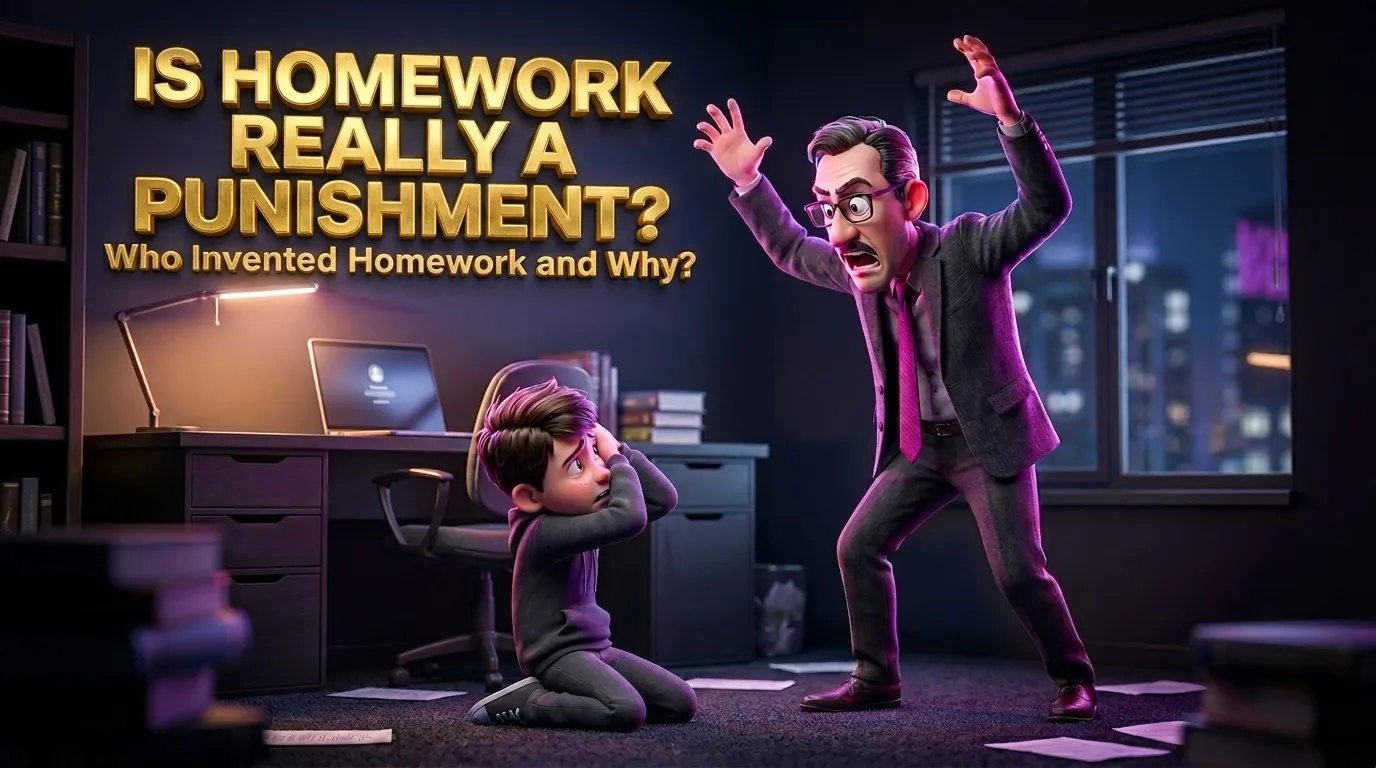
Homework feels like punishment to many students. It follows them home after a long school day, takes away free time, and often shows up when they already feel tired. That is why the internet loves one simple story: an Italian teacher invented homework to punish students.
That story sounds easy to believe. It gives students one person to blame. It also turns homework into a funny school legend. But history does not work that way.
No clear record proves that one person invented homework on one exact day. The famous Roberto Nevilis story appears often online, but it does not come with strong historical proof. A better answer says homework grew over time as schools changed, teachers gave more written tasks, and education systems became more formal.
Apex Essays explains it this way: homework did not begin as one teacher’s revenge. It became a school habit through practice, revision, discipline, exams, and home study.
The Quick Answer: No One Clearly Invented Homework
No single person clearly invented homework. Homework developed slowly through school history.
Teachers have asked students to practice lessons outside class for a long time. Students memorized lines, copied text, solved problems, read books, and prepared for the next lesson before modern school systems even had formal homework rules.
That means the question “who invented homework?” does not have one clean answer.
Many websites name Roberto Nevilis, an Italian teacher linked with Venice and the year 1905. The story says he created homework to punish his students. But this claim does not stand on solid historical ground. It spreads more like an internet legend than a proven fact.
A more accurate answer sounds less dramatic but makes more sense: homework came from old learning habits and became more common as schools grew into organized systems.
Was Homework Really Created as Punishment?
Homework can feel like punishment, but history does not show that punishment created it.
Students often link homework with stress because it comes after school. They may have sports, family duties, part-time work, or just a need to rest. A short task can feel fair. A long or unclear task can feel like a penalty.
That feeling explains why the punishment story became popular. It matches the student experience. When a student asks, “Was homework invented as punishment?” the emotional answer may feel like yes. The historical answer says no.
In the early 1900s, many educators debated homework because they saw too much memorization and repeated drill work. JSTOR Daily notes that homework reform became a serious education topic at the start of the twentieth century, when many assignments focused on memorized facts and recitation. Progressive educators pushed against that style and wanted learning through activity instead.
So homework did not start as one clear punishment tool. Schools used it in different ways. Some teachers may have used extra work as discipline, but that does not prove the whole idea of homework began as punishment.
Who Was Roberto Nevilis, and Did He Invent Homework?
Roberto Nevilis appears in many online answers about homework. The common story says he was an Italian teacher who invented homework in 1905 to punish his class.
The problem is simple: strong historical evidence for this claim remains weak.
Serious history does not give clear records about Roberto Nevilis as the official inventor of homework. The name also appears with different spellings across websites, which makes the claim even weaker. Many pages repeat the same story without showing a reliable original source.
Apex Essays treats the Roberto Nevilis claim as a popular myth, not a confirmed fact.
That does not mean the story has no value. It shows how students feel about homework. They see it as something forced, tiring, and unfair. The story became popular because it speaks to that feeling.
But an article that wants to answer the question honestly should not say, “Roberto Nevilis invented homework,” as if the case has clear proof. A fair answer says people often name him, but history does not confirm him as the true inventor.
Why the Roberto Nevilis Story Became So Popular
The Roberto Nevilis story works well online because it has three things people like: a name, a place, and a reason.
It gives homework a villain. It says an Italian teacher created it. It adds a punishment motive. That makes the story easy to share in memes, videos, and school jokes.
Students also search for phrases like “the guy who invented homework” or “the man who invented homework” because they want a simple answer. They do not want a long history lesson about education systems.
But simple answers can mislead readers.
The real story has no single villain. Homework grew from many teaching habits. It came from classroom practice, written tasks, public schooling, exams, and home study. That history may sound less funny, but it gives students a clearer answer.
Apex Essays keeps this point clear: the punishment story may feel satisfying, but it does not explain where homework actually came from.
Where Did Homework Actually Come From?
Homework came from the basic idea that learning does not always end when class ends.
Long before modern schools, students practiced at home. They memorized lessons, copied writing, prepared speeches, studied religious texts, or read assigned material. Teachers used these tasks to make students repeat what they learned.
Ancient education often relied on memory, recitation, and written practice. Ancient Rome, for example, valued rhetoric, reading, and writing for students who received formal instruction. These practices did not look like today’s worksheets, but they show that after-class study has deep roots.
The idea became more formal when schools became more structured. Once classes had subjects, grade levels, exams, and textbooks, teachers needed ways to extend learning beyond the classroom.
That is how homework became a regular part of school life. It did not arrive all at once. It grew as schools changed.
How Modern Homework Became Part of School Life
Modern homework connects closely with the rise of formal school systems.
As public schools expanded, teachers needed methods to manage large groups of students. They used lessons, drills, exams, reading tasks, and written assignments to keep students moving through the same material.
The Prussian education system often appears in discussions about modern schooling because it shaped many ideas about public education, discipline, teacher training, and state-supported schools. American education reformers showed interest in German and Prussian schooling models during the nineteenth century, and Horace Mann studied European systems before pushing common school reforms in Massachusetts.
Horace Mann did not invent homework. Still, his role matters because he helped build the kind of public school system where homework could become normal.
As schools became more organized, homework gained a clearer place. Teachers assigned reading before class. They gave written work after lessons. They used homework to prepare students for tests. They also used it to keep students on track with school standards.
By the twentieth century, homework had become a common part of school life, though educators kept debating how much students should get.
Why Was Homework Invented If No One Person Created It?
Homework exists because teachers use it for several learning goals.
The first goal is practice. A student may understand a math method in class but forget it later. A few problems at home can help the student repeat the steps.
The second goal is revision. Students often need to review spelling, vocabulary, formulas, dates, or class notes before tests.
The third goal is preparation. A teacher may ask students to read a short chapter before the next lesson so class time can move faster.
The fourth goal is responsibility. Schools often use homework to build study habits. Students learn to plan time, follow instructions, and finish tasks without direct teacher control.
These goals make sense when homework has a clear purpose. They become weak when teachers assign busywork, long tasks, or unclear instructions.
Apex Essays often sees this issue in student work. Homework creates more value when it connects to class learning. It creates stress when it feels random, too long, or poorly explained.
Who Invented School Homework in America?
No one person invented school homework in America.
Homework entered American school life through public education, textbooks, exams, teacher habits, and school policy. As schools became more formal in the nineteenth and twentieth centuries, take-home assignments became more common.
Horace Mann played a key role in the common school movement, which supported free, public, non-sectarian education for children. His work shaped American schooling, but he did not create homework as a single invention.
The United States education system used homework because it fit a growing school model. Teachers had classes to manage. Students had lessons to review. Schools had grades, tests, and academic goals.
So when readers ask, “Who invented homework in America?” the answer stays the same: no single person. Homework became part of school practice as the school system grew.
What About Homework in India, Finland, and Other Countries?
Homework did not enter every country in the same way.
In India, homework came through formal schooling, exams, textbooks, and classroom routines. Schools used take-home tasks to support memory, practice, and test preparation. No single person invented homework in India.
Finland often appears in homework debates because people claim Finnish schools have no homework. That claim needs care. Finland has not passed one simple national “no homework law.” Teachers use professional judgment, and homework often stays light compared with many other systems. Some sources that study Finnish school practice describe the “no homework” idea as a myth, not a strict national rule.
This shows an important point. Homework depends on school culture, teacher choice, subject level, and student age. Some countries use heavy homework. Some schools keep it light. Some teachers avoid it for young children and use it more for older students.
The origin question may sound global, but the answer often comes down to local school systems.
Who Invented Exams and Homework?
No one person clearly invented exams and homework together.
Exams and homework developed for different reasons. Exams help schools measure what students know. Homework helps students practice, revise, or prepare outside class.
Both became common because modern schools needed systems. Teachers needed ways to assign lessons. Schools needed ways to track progress. Students needed ways to show what they learned.
As public education expanded, exams and homework started working side by side. A student learned in class, practiced at home, and then took a test. This pattern still shapes many schools today.
That does not mean every homework task prepares students well. Some tasks help. Some waste time. The difference comes from design, purpose, and workload.
Why Do Teachers Still Give Homework Today?
Teachers give homework because they want students to keep working with a lesson after class ends.
In math, homework often gives students more practice with formulas, steps, and problem solving. Apex Essays supports students with math homework help when class examples do not make the method clear enough.
In reading, homework may ask students to finish a chapter or write notes. In science, it may ask students to apply a formula or explain a process. In history, it may ask students to compare events, people, or causes.
Teachers also use homework to see what students understand. If many students miss the same type of question, the teacher can review that idea again.
Still, homework should not replace good teaching. It should support learning, not carry the whole lesson alone.
When several subjects assign long tasks on the same night, homework can become too much. That is when students need planning, clear instructions, and fair limits. Apex Essays provides homework help for students who need academic support with difficult school tasks.
When Homework Supports Learning
Homework works better when it stays clear, short, and tied to the class lesson.
A good task has a reason. It gives students practice with something they just learned. It helps them review for a test. It asks them to think about a topic before the next class.
Research on homework does not give one simple answer for every age group. Reports often show a stronger link between homework and achievement for older students than for younger children. Time Magazine summarized Harris Cooper’s homework research and noted that the relationship between homework and achievement appears stronger in grades seven through twelve than in early grades.
That matters because a seven-year-old and a high school student do not need the same amount of homework. Younger students need rest, play, reading time, and family time. Older students may need more independent study because their courses ask for deeper work.
Some subjects also need guided practice. Apex Essays offers statistics homework help for students who need support with data, charts, probability, and analysis.
When Homework Hurts Student Life
Homework can hurt student life when schools give too much of it or fail to explain the purpose.
Students may lose sleep. They may skip hobbies. They may feel pressure when every teacher treats one class as the only class that matters. Parents may also step in too much, which can turn homework into a family conflict.
Long homework does not always mean strong learning. A short, clear task can teach more than two hours of repeated busywork.
The research debate also supports this concern. Homework can connect with achievement for older students, but too much work may lower the value of study time and increase stress. Time Magazine’s summary of Cooper’s research notes concerns such as fatigue, negative feelings about learning, and less leisure time.
This is why the “homework as punishment” idea feels real to many students. Even if homework did not begin as punishment, poor homework can feel like one.
Apex Essays sees this pattern often. Students do not always reject learning. They reject tasks that feel unclear, unfair, or disconnected from the lesson.
Why the Quality of Homework Matters More Than the Amount
The amount of homework matters, but quality matters more.
A useful task tells students what to do, why it matters, and how it connects to class learning. It does not repeat the same skill past the point of learning. It does not punish students for needing more time.
Teachers can make homework stronger by using clear questions, fair length, and direct links to the lesson. Students can handle homework better when they plan time, ask questions early, and avoid leaving every task for late night.
Some homework asks students to build research skills. In that case, the task should have a clear topic, source plan, and writing goal. Apex Essays shares guidance on effective research assignments for students and educators who want academic tasks to feel more useful.
Homework also changes by subject. A reading task does not work like a physics problem. A history paragraph does not work like a statistics table. This is why teachers need to match homework with the skill they want students to practice.
How Homework Became a Debate Instead of a Simple School Rule
Homework has faced debate for more than a century.
In the early twentieth century, many educators questioned memorization-heavy assignments. Progressive education thinkers wanted students to learn through activity and real experience, not only recitation. JSTOR Daily explains that homework reform debates grew during this period because many assignments focused on memorized facts.
Later, homework debates changed with society. Parents worried about pressure. Teachers worried about standards. Students worried about time. Schools tried to balance learning with mental health, family life, and fairness.
Today, the debate still has no single answer.
Some students need more practice. Some need less work and more feedback. Some need clearer tasks. Some need support in one subject but not another.
Physics shows this well. A student may understand the formula but not know when to use it. Apex Essays provides physics homework help for students who need clearer steps in problem-based science work.
The homework debate should not ask only, “Should homework exist?” A better question asks, “What kind of homework helps students learn without wasting their time?”
Is Homework a Learning Tool or a School Habit?
Homework can work as a learning tool, but schools often turn it into a habit.
A learning tool has a goal. It helps students practice, review, prepare, or think. A habit happens because the school expects teachers to assign something, even when the task does not add much value.
Students notice the difference.
When homework helps them solve problems better, they may still dislike it, but they understand the reason. When homework feels random, they call it punishment.
This is where the history of homework matters. Homework did not come from one simple event. It came from school routines. Some routines helped students learn. Some became too rigid.
Apex Essays believes students deserve clear academic tasks, not busywork. A homework task should make the lesson easier to understand, not just make the evening longer.
So, Is Homework Really a Punishment?
Homework is not really a punishment in its historical origin.
The popular story says one teacher invented homework to punish students. The stronger historical answer says homework developed over time through education systems, classroom practice, written work, exams, and study routines.
That does not erase how students feel.
Homework can feel like punishment when it takes too long, lacks purpose, or adds stress after school. It can also support learning when teachers keep it clear, fair, and tied to class goals.
So the honest answer has two parts.
Homework was probably not invented as punishment. But bad homework can feel like punishment.
That is the difference students need to know.
Why Students Still Ask Who Invented Homework
Students keep asking who invented homework because the question carries emotion. It is not only about history. It is about school life.
A student who searches “who invented homework and why” often wants a quick answer, but also wants to know why schools still assign work after class. The question points to stress, curiosity, and sometimes frustration.
It also shows how school legends spread. One catchy story can outrank a careful answer because it feels more fun. The Roberto Nevilis story gives students a name. The real history gives them a better explanation.
Apex Essays handles the question with balance: name the myth, explain why it spread, and give the clearer history.
That approach helps readers avoid false certainty. It also respects the fact that homework affects real student life.
Final Answer: Who Invented Homework and Why?
No single person clearly invented homework.
Roberto Nevilis often appears online as the person who invented homework, but strong historical proof does not confirm that claim. The story that homework began as punishment sounds popular, but it works more like a school myth than a proven fact.
Homework came from older learning habits and became part of modern education as schools grew more formal. Teachers used take-home work for practice, revision, preparation, discipline, and study routines.
In America, homework spread through public schooling, textbooks, exams, and teacher-led classroom systems. In other countries, it developed through their own school cultures and policies.
So, is homework really a punishment?
Not by origin. Homework started as part of learning practice, not as one clear act of revenge. But it can feel like punishment when schools give too much of it or fail to make the task useful.
Apex Essays sums it up simply: students may want one person to blame, but history does not give us one clear villain. Homework grew with schools, and its value still depends on how teachers use it today.