 +1 (417) 221-3749
 Live Chat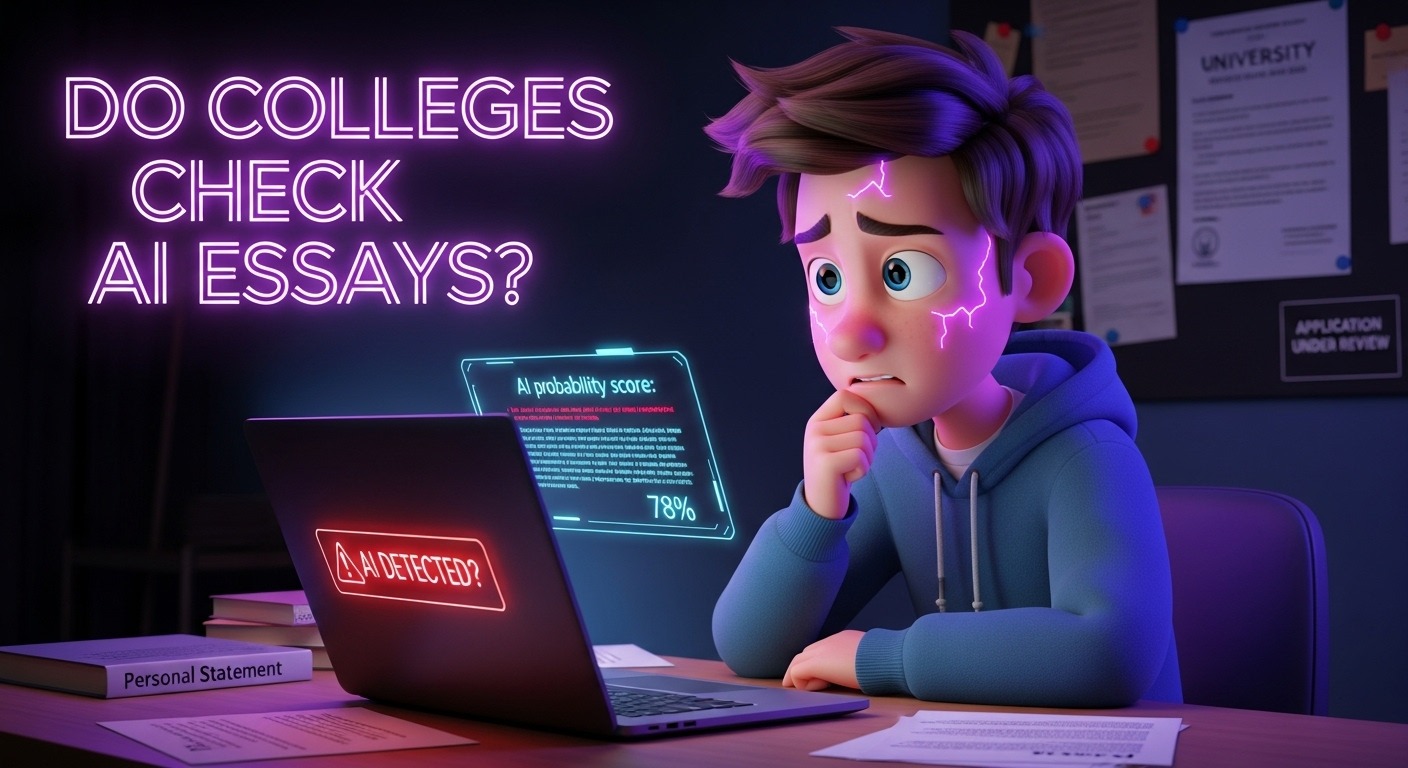
College admissions have always focused on one thing above all: your voice. Now that tools like ChatGPT exist, a new question keeps coming up: do colleges check for AI in essays, and if they do, how serious is it?
Admissions teams across the United States have started adapting their review process. They do not rely on a single method. Instead, they combine human judgment, policy guidelines, and technical tools to evaluate whether an essay reflects a real student.
This matters because your personal statement is not just about writing. It is evidence of your thinking, your growth, and your intent to study. When that feels artificial, it raises concerns during review.
At Apex Essays, students often ask whether AI use leads to rejection or if it can pass unnoticed. The answer is not simple. Detection exists, but it is not perfect. What matters more is how your essay reads to a trained reviewer.
What Admissions Officers Actually Look for in a Personal Statement
Admissions officers do not begin with AI detection tools. They begin with reading.
Their first goal is to understand who you are beyond grades and test scores. Every sentence in your essay helps them form that impression.
The Human Element: They are Trained to Identify
Admissions officers read thousands of essays every cycle. Over time, they develop a strong sense of what authentic student writing sounds like.
They look for:
Personal reflection that feels specific, not generic
Emotional clarity tied to real experiences
Logical progression of thought that shows growth
Small imperfections that make writing feel natural
AI-generated essays often sound smooth, but they lack lived detail. They tend to generalize rather than show moments.
For example, a real student might describe a single classroom failure and what it taught them. AI writing often expands broadly without grounding the story.
This difference becomes clear quickly during evaluation.
Why Authentic Voice Matters More Than Perfect Grammar
Many students believe perfect grammar equals a strong essay. That is not how admissions teams think.
They prefer clarity over perfection.
A slightly imperfect sentence that carries genuine meaning holds more value than polished but empty phrasing. When essays sound too refined or detached, reviewers may question authorship.
At Apex Essays, students learn that authenticity carries more weight than structure alone. A real voice builds trust. Moreover, trust plays a key role in the college application review process.
How Universities Identify AI-Generated Writing
Colleges do not depend on a single detection method. They combine software tools with human analysis.
This layered approach helps them reduce false conclusions while still protecting academic integrity.
AI Detection Software Currently in Use by Institutions
Some universities experiment with AI detection tools that analyze writing patterns. These tools estimate whether a text is likely to have been generated by a machine learning system.
Common features include:
Pattern recognition based on training data
Sentence predictability scoring
Comparison with known AI-generated outputs
However, institutions treat these tools as indicators, not final proof.
Many admissions teams understand that detection systems can produce false positives. That means a genuine essay might still get flagged.
The Difference Between Plagiarism Detection and AI Content Analysis
Plagiarism detection checks if the content matches existing sources.
AI detection works differently. It analyzes how the text is written, not where it came from.
This includes:
Sentence structure repetition
Word predictability patterns
Lack of stylistic variation
Plagiarism tools rely on databases. AI detection relies on probability.
This distinction matters because an essay can be original but still appear machine-generated.
Probability Scoring and Natural Language Pattern Recognition
AI detection tools often produce a score. This score suggests how likely it is that AI generated the text.
These systems use natural language processing detection methods. They measure how predictable the writing is compared to human patterns.
Human writing tends to vary more. AI writing often follows smoother, more consistent patterns.
However, no system is fully accurate.
Can These Tools Reliably Distinguish Humans from AI Writing?
The short answer is no.
Detection tools struggle with accuracy, especially when:
A student edits AI-generated text
A strong writer produces highly structured content
Mixed writing (human + AI) is used
This is why admissions teams never rely solely on tools. Students wondering about detection in academic submissions may also find it useful to understand how Turnitin handles AI-generated content; the underlying logic overlaps with admissions review systems.
At Apex Essays, this is one of the most common concerns students raise, especially when trying to understand detection limits.
Where Do Colleges Stand on AI Use in Applications?
Policies around AI are still evolving, but most institutions share one core expectation: honesty.
Ivy League and Selective Universities Known Positions
Highly selective universities tend to emphasize authenticity.
They may not publicly list AI bans in detail, but their academic integrity policies apply to the application stage as well.
This means:
Submitting work not written by you can be considered misrepresentation
Essays must reflect your own thinking and experience
In practice, these schools rely heavily on human evaluation rather than automated detection.
Common App and Coalition App Platform-Level Policies
Application platforms like the Common App emphasize honesty in submissions.
They require students to confirm that:
The essay is their own work
The information provided is accurate
They do not run AI detection tools directly. Instead, they place responsibility on the applicant.
How Academic Integrity Policies Extend to Admissions
Academic integrity does not start after enrollment. It begins with your application.
Submitting AI-generated content may fall under:
Misrepresentation
Academic misconduct in admissions
Violation of honesty policies
These policies allow colleges to take action if they believe an application lacks authenticity.
Apex Essays often highlights this point to students who assume policies apply only after acceptance.
What Happens When an Essay Appears AI-Generated
Not every flagged essay leads to rejection. Admissions teams review context before making decisions.
Scenarios That Raise Red Flags During Review
Certain patterns can trigger closer inspection:
The essay tone does not match the rest of the application
Writing feels generic or overly polished
Lack of specific personal details
Sudden shifts in writing style
When these appear, admissions officers may question authenticity.
Application Rejection vs. Deferred Review: How Decisions Are Made
If concerns arise, colleges may respond in different ways:
Continue reviewing with caution
Request additional information (rare but possible)
Reject the application if misrepresentation seems clear
Most decisions depend on how strongly the essay conflicts with other parts of the application.
Academic Misconduct Implications Beyond the Application Stage
In some cases, issues may extend beyond rejection.
If AI-generated essays are discovered after admission, institutions may:
Revoke offers
Apply disciplinary action
This reinforces the importance of honesty in college applications.
Can AI Writing Pass Detection Tools in 2026 Applications?
Some students ask if AI writing can avoid detection completely.
The reality is more complex.
Why Detection Is Inconsistent Across Platforms
Different tools use different models.
This leads to inconsistent results:
One tool may flag an essay
Another may mark it as human
There is no universal system across colleges.
What a High AI Probability Score Actually Signals to a Reviewer
A high score does not prove AI use.
It simply signals that the text resembles AI patterns.
Admissions officers treat this as a prompt to read more carefully, not as evidence.
Factors That Confuse Automated Detection Systems
Several factors can affect detection accuracy:
Strong grammar and structure
Limited variation in sentence length
Formal tone without personal detail
Even genuine essays can trigger these signals.
For students navigating the writing process under scrutiny, working with a professional on your college essay ensures the work reflects your genuine voice, something no detection tool can replicate.
Apex Essays often emphasizes this because authenticity reduces risk more effectively than trying to outsmart detection systems.
Ethical Boundaries Around AI Assistance in College Applications
AI itself is not the problem. The issue lies in how it is used.
Where AI as a Tool Ends and AI as the Author Begins
Using AI for brainstorming or idea generation may be acceptable.
But when AI writes the full essay, it crosses into authorship.
Admissions officers expect:
Your ideas
Your structure
Your expression
Once AI replaces those, the essay no longer represents you.
How Admissions Officers Verify Essay Authenticity Beyond Software
Human reviewers rely on:
Consistency across application materials
Alignment with recommendation letters
Writing style compared to short answers
They build a full picture of the applicant.
This holistic review makes it harder for AI-generated essays to blend in naturally.
What Holistic Review Actually Means for Your Application File
Holistic review looks at everything together:
Grades
Activities
Essays
Recommendations
If one piece feels
At Apex Essays, this approach helps students keep control of their voice while improving clarity.
Characteristics of a Personal Statement That Reads as Genuinely Yours
Admissions officers do not just look for errors or patterns. They look for signals that a real person wrote the essay. These signals often appear in subtle ways that AI struggles to reproduce.
Structural and Stylistic Signals of Original Writing
A genuine essay rarely feels perfectly balanced.
It may include:
Slight shifts in tone that reflect real thinking
Sentences that vary in length and rhythm
Natural transitions that come from personal reflection
AI writing often follows a predictable structure. It introduces, explains, and concludes uniformly.
Human writing feels less mechanical. It may pause, reflect, or even circle back to an earlier idea.
Admissions officers recognize this difference quickly.
At Apex Essays, students are encouraged to retain these natural patterns rather than edit them out. That slight imperfection often signals authenticity.
How Specific Detail and Personal Experience Build Credibility
Generic writing creates distance. Specific detail builds trust.
For example:
Mentioning a real classroom moment
Describing a challenge with clear context
Explaining how a decision changed your perspective
These details anchor your story.
AI tends to generalize. It avoids risk by staying broad. But admissions officers expect depth.
Students who need guidance in building that structure from scratch often turn to professional personal statement writing support to develop an essay that reflects their story accurately.
Apex Essays focuses on helping students bring forward real experiences instead of replacing them.
Voice Consistency Across Your Entire Application Package
Your essay does not exist alone.
Admissions officers compare it with:
Short answer responses
Activity descriptions
Recommendation letters
If your essay sounds completely different, it raises questions.
Consistency matters.
A genuine voice stays stable across all parts of your application. It may vary slightly, but it should feel like the same person is speaking.
This is one of the most reliable ways admissions teams assess authenticity.
How to Approach Your Application Essay Without Risk
The safest approach is not to avoid detection. It is to build a strong, honest essay from the start.
Reviewing Your Draft Against Common AI Detection Patterns
Before submitting, review your essay carefully.
Ask yourself:
Does it sound too perfect?
Are the ideas too general?
Does it reflect real experiences clearly?
If the essay feels overly smooth or vague, revise it.
Break long, uniform sentences. Add specific moments. Let your personality come through.
These changes improve both readability and authenticity.
Questions Admissions Officers Ask That AI Cannot Answer for You.
Admissions officers often look beyond the text itself.
They ask:
What does this student value?
How did this experience shape them?
What makes this story unique?
AI cannot answer these questions with real depth.
Only your lived experience can provide those answers.
This is why relying fully on AI creates risk. It removes the very element admissions teams care about.
Building an Essay That Represents Your Academic and Personal Journey
Your essay should connect your past with your future.
It should show:
What you learned
How you changed
What do you plan to do next
This progression forms a narrative.
For students who want additional guidance on starting strong, writing powerful essay hooks is often where a genuine voice first becomes visible to a reader.
Apex Essays often highlights that the opening lines set the tone for everything that follows.
Colleges do check for AI in application essays, but not in the way many students expect.
They do not rely only on detection tools. They rely on human judgment, consistency, and context.
An essay that reflects your real experiences will always stand stronger than one built entirely by AI.
At Apex Essays, students learn that the goal is not to avoid detection. The goal is to present a voice that feels real, grounded, and consistent across the entire application. That approach aligns with how admissions teams actually evaluate essays, and it removes the uncertainty that comes with trying to outsmart the system.