 +1 (417) 221-3749
 Live Chat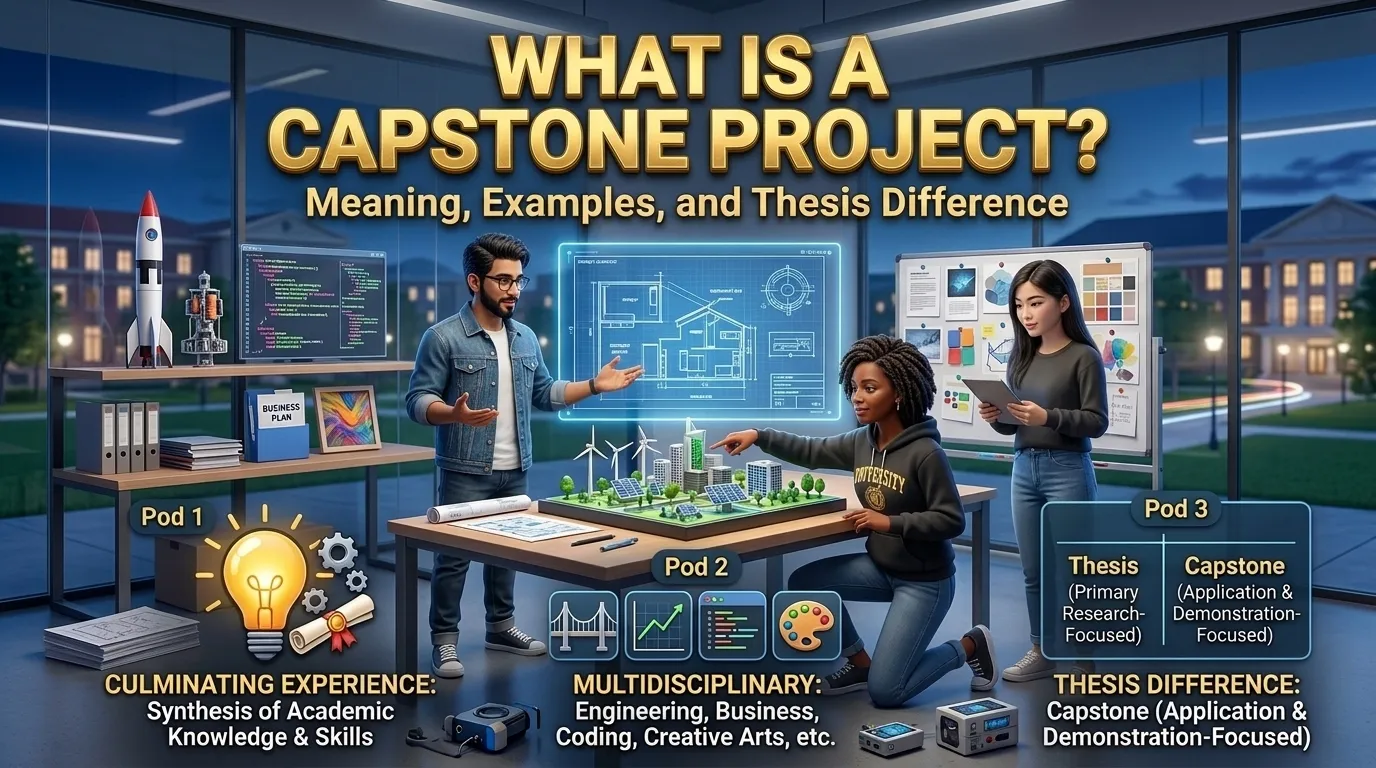
Capstone project sounds like one fixed assignment, but it can take different forms across schools and programs. In one course, it may be a research report. In another, it may be a business plan, software build, nursing improvement plan, design model, portfolio, or final presentation.
A capstone project is a final academic project that asks students to use what they have learned in their program to solve a problem, answer a practical question, or create a meaningful final product. It usually appears near the end of a course, degree, or program because it brings earlier learning together in one larger task.
What Is a Capstone Project?
A capstone project is a final project that shows how well a student can apply knowledge from a course or degree program. It is not always just a paper. Depending on the subject, it may include research, planning, design, fieldwork, data analysis, a presentation, or a practical solution.
The main idea is application. A student is expected to take what they have learned and use it in a real or realistic academic situation. For example, a business student might create a customer retention plan for a local café. A computer science student might build a room-booking app and explain the testing process. A nursing student might design patient education material for diabetic patients who often misunderstand medication timing.
The word “capstone” matters because it signals the final stage of learning. It is meant to bring different skills together, such as research, writing, problem-solving, communication, and subject knowledge. The exact format depends on the course brief, program level, and instructor requirements.
What Does a Capstone Project Mean in College or University?
A capstone project is more than a final assignment. Colleges and universities use it to measure whether students can combine the knowledge and skills they have developed throughout their program. Instead of testing one subject, it asks students to connect ideas from multiple courses and apply them to a realistic academic or professional challenge.
Many institutions place the capstone in the final semester because students are expected to work more independently than they did earlier in their studies. Depending on the program, the project may involve research, designing a product, solving a practical problem, completing a professional portfolio, or presenting recommendations based on evidence.
Although every institution has its own requirements, most capstone projects assess similar abilities, including:
Applying subject knowledge to a real or simulated problem
Finding and evaluating reliable sources
Organizing information into a logical project
Supporting decisions with evidence
Presenting findings clearly in written, visual, or oral form
The emphasis is usually on showing what a student can do with their knowledge rather than how much information they can remember.
High School, Undergraduate, and Master's Capstones
The word capstone stays the same, but the expectations become more advanced at each academic level.
High school capstones are often designed to introduce students to independent learning. A project might involve community service, a presentation, a portfolio, or a short research report that demonstrates planning, organization, and communication skills.
Undergraduate capstones usually require students to solve a discipline-specific problem. A marketing student may prepare a campaign for a local business, while an engineering student might design and test a prototype that addresses a practical need.
Master's capstones often focus on professional practice. Instead of producing original academic research, students may evaluate an existing problem, recommend evidence-based improvements, or develop a project that can be applied directly in their field. For example, an MBA student could create a strategic growth plan for a small company, while a nursing student might develop a quality improvement initiative to reduce patient readmissions.
The academic level influences the depth of analysis, the amount of independent work expected, and the complexity of the final submission. It does not change the central purpose of a capstone project: demonstrating that learning can be applied in a meaningful way.
Why Do Schools Assign Capstone Projects?
Schools use capstone projects to measure something traditional exams cannot: whether students can apply what they have learned to a realistic academic or professional challenge.
Throughout a degree program, students complete separate assignments that focus on individual topics. A capstone brings those skills together in one project. Instead of recalling facts from a single course, students are expected to research a problem, evaluate evidence, make informed decisions, and communicate their findings clearly.
This approach also prepares students for situations they may encounter after graduation. Many capstone projects are based on real organizations, community issues, workplace scenarios, or industry challenges, making the experience more practical than a standard classroom assignment.
A well-designed capstone project usually helps students demonstrate their ability to:
Apply knowledge from multiple courses.
Solve a clearly defined problem using evidence.
Think critically and justify decisions.
Manage a long-term academic project.
Present ideas in a professional and organized way.
While the format differs between institutions, the purpose remains consistent: to show that a student can move beyond learning concepts and use them effectively in practice.
One point that often surprises students is that a capstone is not always about finding new knowledge. In many professional programs, the emphasis is on applying existing knowledge to improve a process, solve a practical issue, or develop a useful product. That is why two students from different departments can both complete a capstone project while producing entirely different types of work.
How Do Capstone Projects Work?
Most capstone projects follow a series of stages, although the exact process depends on the course and institution. Understanding these stages early makes the project easier to plan and reduces the risk of major revisions near the submission deadline.
Choosing a Focused Capstone Topic
Everything begins with selecting a manageable topic. This is where many projects become difficult before the writing even starts.
A broad subject such as mental health or artificial intelligence is usually too large for a single capstone. A focused topic gives the project a clear direction from the beginning.
For example:
Too broad: Mental health among university students
Focused: The effect of peer support programs on first-year nursing students' exam stress
A focused topic makes it easier to develop research questions, collect evidence, and stay within the project scope.
Preparing the Proposal
After choosing a topic, students usually submit a proposal for approval.
A proposal explains:
The problem being addressed
The project's objective
Why the topic matters
The planned research or project method
Expected outcomes
A preliminary timeline
Approval at this stage helps ensure the project is realistic before significant time is invested.
Research and Gathering Evidence
Once the proposal is approved, students begin collecting reliable evidence.
Research-based capstones often include academic journal articles, books, government publications, industry reports, and professional guidelines. Practice-based projects may also include interviews, surveys, observations, design testing, or organizational data.
The quality of the evidence often has a greater impact on the final project than the number of sources collected.
When a capstone includes a formal research report, writing a focused thesis statement helps keep every section aligned with the main objective.
Developing the Final Project
The next stage is turning research into a structured piece of work.
Depending on the discipline, the final submission may include:
An introduction explaining the problem
A review of relevant research
Project methodology or design process
Findings or project outcomes
Discussion and analysis
Recommendations
Conclusion
Presentation or project demonstration, if required
Not every capstone follows this exact format. Engineering students may present a working prototype, while education students may submit a curriculum design and classroom implementation plan. The final product should always reflect the learning outcomes of the program rather than follow a single universal template.
Research-based capstones often include a findings chapter, so presenting research findings clearly becomes an important part of the final report.
Presentation and Assessment
Many capstone projects end with a presentation, poster session, portfolio review, or oral defense.
During this stage, students explain their decisions, answer questions, and demonstrate how their work addresses the original project objective. In many programs, this presentation forms part of the final assessment alongside the written submission.
Rather than treating the presentation as a separate task, it should reinforce the evidence, analysis, and conclusions already developed throughout the project.
What Does a Capstone Project Look Like?
A capstone project can look like a long paper, but it can also be a product, portfolio, presentation, design model, care plan, business report, software build, or practical solution. The final format depends on the course brief and the subject area.
In many programs, the written part is only one piece of the project. A computer science capstone may include code, testing notes, screenshots, and a short report. An engineering capstone may include sketches, calculations, a prototype, and a presentation. A nursing capstone may include a patient care improvement plan supported by research.
A typical capstone may include:
A clear problem or project aim
Background research
Project method or design process
Evidence, data, or field observations
Analysis of findings
Final product, report, or recommendation
Presentation or defense
The safest way to understand what a capstone should look like is to read the course instructions before choosing the topic. The required format should guide the project, not the other way around.
Capstone Project Examples by Subject
Capstone examples are easiest to understand when they are linked to a specific field. A strong capstone usually solves a focused problem, not a broad topic.
Business and MBA Capstone Examples
A business student might study why a small café loses repeat customers after the first visit. The final project could include customer survey results, competitor pricing, service timing, loyalty ideas, and a practical retention plan.
An MBA capstone may focus on market entry, financial planning, operations improvement, or growth strategy for a real or simulated company.
Nursing and Healthcare Capstone Examples
A nursing student might create a discharge education sheet for diabetic patients who often misunderstand medication timing. The project may include evidence from clinical guidelines, patient education research, and a plan for improving communication before discharge.
A DNP capstone may focus on practice improvement, patient safety, workflow issues, or healthcare quality outcomes.
Engineering and Design Capstone Examples
An engineering student might design a low-cost water filtration model for a small community. The project may include design sketches, material testing, cost limits, safety issues, and final performance results.
A design capstone often includes both technical explanation and a working model or prototype.
Computer Science and Data Science Capstone Examples
A computer science student might build a room-booking app for a campus office. The final submission may include user roles, database tables, login features, testing errors, and known system limits.
A data science capstone might analyze student attendance patterns to predict course withdrawal risk. The project could include data cleaning, model selection, accuracy testing, and ethical limits.
Education Capstone Examples
An education student might create a reading support plan for Grade 4 students who have trouble with nonfiction texts. The final project may include lesson materials, assessment samples, classroom strategies, and reflection on what worked.
Capstone Project vs Thesis: What Is the Difference?
A capstone project usually applies knowledge to a practical problem, while a thesis focuses more on answering a research question through formal academic research. Both can involve research, but they do not always ask for the same type of work.
A thesis often requires a deeper research argument. A capstone is often more applied. For example, a thesis may study how peer feedback affects writing confidence among college students. A capstone may create a peer feedback system for a writing center and explain how it could be used.
Many students also confuse a thesis with a dissertation. Understanding the difference between a thesis and dissertation makes these academic requirements easier to separate.
Capstone vs Dissertation
A dissertation is usually longer and more research-heavy than a capstone. It is common in doctoral programs and often requires original research that contributes to an academic field.
A capstone may appear in undergraduate, master’s, or professional programs. It usually focuses on applying knowledge, solving a practical issue, or creating a final product.
Capstone vs Research Paper
A research paper usually focuses on explaining, analyzing, or arguing about a topic using sources. A capstone may include a research paper, but it often goes beyond writing alone.
For example, a research paper might analyze cybersecurity risks in small businesses. A capstone might create a cybersecurity awareness plan for a local business and explain how the plan should be used.
Simple Comparison Table
| Academic Task | Main Focus | Common Output |
|---|---|---|
| Capstone project | Applying knowledge to a real or realistic problem | Report, product, portfolio, plan, presentation |
| Thesis | Answering a research question | Formal research paper |
| Dissertation | Producing advanced original research | Long doctoral research study |
| Research paper | Analyzing a topic through sources | Essay or formal paper |
How Long Does a Capstone Project Take?
Most capstone projects take one academic term to complete, although some begin earlier with topic approval or proposal planning. A short undergraduate capstone may last eight to twelve weeks, while larger projects often run throughout an entire semester. Graduate and professional programs sometimes spread the work across two terms because the research or practical component is more detailed.
The timeline depends on several factors, including:
The size of the project
Research requirements
Data collection methods
Whether the project is completed individually or in a group
Revision and presentation deadlines
A realistic schedule usually includes time for choosing a topic, preparing a proposal, collecting evidence, writing the report, receiving feedback, making revisions, and preparing the final presentation. Leaving everything until the final weeks often creates unnecessary pressure because many stages depend on the completion of earlier work.
Are Capstone Projects Hard?
A capstone project is challenging because it combines several academic skills into one assignment rather than testing a single topic. Most students find project planning more demanding than the writing itself.
The difficulty usually depends on:
Choosing a realistic topic
Managing time effectively
Finding reliable academic sources
Organizing research into a clear structure
Following the course requirements carefully
One mistake appears repeatedly across different subjects. Students often choose a topic because it sounds impressive instead of choosing one they can realistically finish within the available time. A focused project usually produces stronger results than an ambitious topic that becomes too difficult to manage.
Group capstones introduce another challenge. While responsibilities can be shared, success depends on communication, clear deadlines, and equal participation. Individual projects offer more control but require careful planning from beginning to end.
A capstone is demanding, but it is designed to measure growth rather than perfection. Breaking the work into smaller stages makes the project much easier to manage.
Should You Put a Capstone Project on a Resume?
Yes—many graduates benefit from including a capstone project on their resume, especially when they have limited professional experience or when the project closely matches the role they are applying for.
A capstone can demonstrate practical skills that employers value, including research, critical thinking, communication, project management, technical ability, and problem-solving.
Instead of listing only the project title, briefly explain what was accomplished. Focus on measurable outcomes whenever possible.
For example:
Capstone Project: Campus Room Booking System
Designed and developed a web application for managing room reservations.
Built a relational database to store booking information.
Tested user authentication and scheduling features.
Prepared technical documentation and presented project outcomes.
Business, engineering, nursing, education, and computer science graduates often benefit the most because their capstone projects closely reflect workplace tasks.
A capstone should not replace professional experience on a resume, but it can strengthen an application by showing how academic knowledge was applied to a realistic project.
Common Mistakes to Avoid in a Capstone Project
Many capstone projects become more difficult because of planning mistakes rather than writing problems. Avoiding a few common issues early can save considerable time later.
Choosing a Topic That Is Too Broad
Broad topics create broad projects. A clear, focused problem is much easier to research and complete successfully.
Ignoring the Project Brief
Some students begin researching before reading the assessment requirements carefully. This often leads to unnecessary revisions because the final submission does not match the expected format.
Waiting Too Long to Start
Capstones involve several connected stages. Delaying the proposal or research usually affects every stage that follows, including writing, editing, and presentation preparation.
Using Weak or Outdated Sources
Reliable academic journals, books, government publications, and professional reports provide a stronger foundation than unsupported online opinions. The quality of evidence often matters more than the number of references.
Treating Every Section Separately
A strong capstone reads as one connected project. The research question, methodology, analysis, and conclusion should support the same objective from beginning to end.
When Academic Guidance May Help
Some parts of a capstone project require more planning than others. Students commonly seek additional guidance when narrowing a topic, organizing a proposal, reviewing academic sources, or connecting different sections into one logical report.
At Apex Essays, capstone guidance starts with the project brief because that document decides the topic scope, format, source needs, and final submission style.
When a project includes a substantial review of existing research, literature review guidance can help students organize evidence before drafting begins.
As the project develops, keeping the proposal, research, analysis, and conclusion aligned becomes increasingly important. When those pieces begin to feel disconnected, capstone project support can help students understand how each stage fits together before the final submission.
Final Takeaway
A capstone project is the final opportunity to demonstrate how knowledge gained throughout a program can be applied to a meaningful academic or professional challenge. Although the format differs between disciplines, the goal remains the same: bringing research, analysis, problem-solving, and communication together in one well-planned project.
Understanding the purpose, process, and expectations behind a capstone makes the assignment far less confusing. With a focused topic, realistic timeline, and careful planning, students can approach the project with greater confidence and produce work that reflects the skills they have developed throughout their studies.